
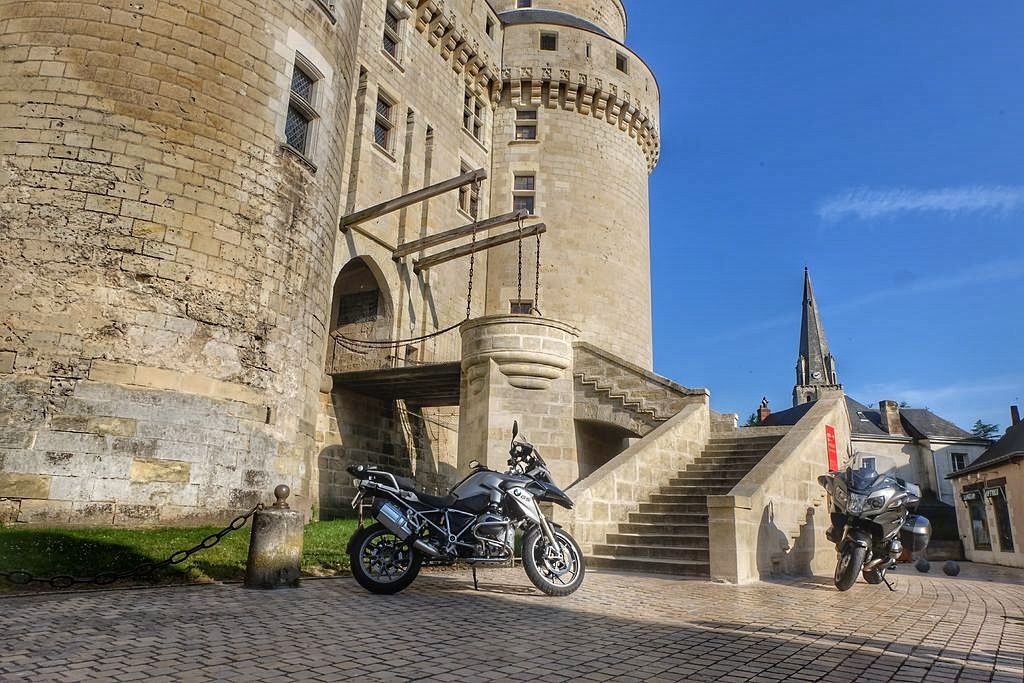
The Loire Valley and its many tributaries offer a wide range of motorcycle routes, highly appreciated by riders who come to Touraine to discover the famous Loire Valley castles.
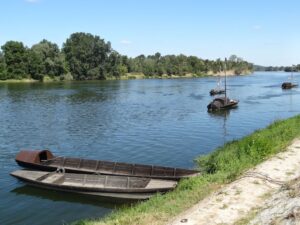
This wooded region is watered by three major rivers—the Loire and its tributaries, the Indre and the Cher. It is rich in mysterious relics from the Romanesque period, towering medieval fortresses, and Renaissance châteaux that mark the transition from regional conflict to an era of national peace. It is also a land of market gardens and magnificent ornamental parks, whose geometric layouts perfectly reflect mankind’s control over nature. A motorcycle journey through what is often called the Garden of France.
A motorcycle getaway to the most beautiful châteaux of the Indre, the Cher, and the Loire

Azay le Rideau
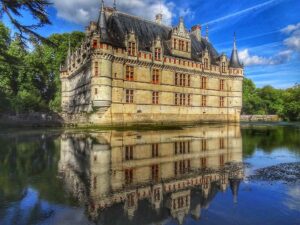
The elegance of Château d’Azay-le-Rideau, rising above the waters of the Indre River and partly nestled among trees, is certainly one of the most familiar sights in the Loire Valley. The charm of this delightful early 16th-century Renaissance jewel, conceived as a residence rather than a fortress, is undeniable. Its delicacy provides a pleasing contrast to the grandeur—and sometimes the pomp—of many other châteaux in the region.
The exterior and its setting are remarkable, though difficult to fully appreciate from the road, making a visit essential despite Azay’s great popularity. The small town also features an interesting 11th-century church, Saint-Symphorien, with its unusual gabled façade.
The village of Azay itself is lively and elegant, with upscale shops and restaurants, yet it retains its charm. The mills and houses along the water are well worth seeing. Quiet roads following the river to the east and west of the town are a real pleasure to ride and allow you to escape the crowds.


Rigny-Ussé, the castle of Sleeping Beauty
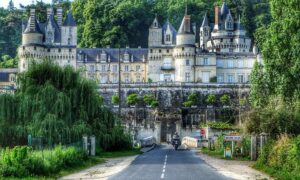
The Château d’Ussé can only be approached from the north, via the small road that follows the southern bank of the Loire. From afar, its extraordinary forest of towers, machicolations, and turrets set against wooded hills seems to rise straight out of a fairy tale—and Ussé was indeed the model used by Charles Perrault for the castle in Sleeping Beauty.
Originally a medieval fortress, Ussé was steadily enlarged between the 15th and 18th centuries, yet its white façade displays remarkable harmony. The château is privately owned; its interior is interesting, but its most notable features date from the Renaissance, especially the 16th-century chapel and the Aubusson tapestries depicting the life of Joan of Arc.
Château de Villandry and its French formal gardens
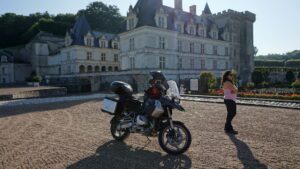
Villandry was built largely in the 16th century, yet it retains the great keep of the original medieval fortress. Extensively restored in the 19th century, the château stands proudly above the confluence of the Loire and the Cher.
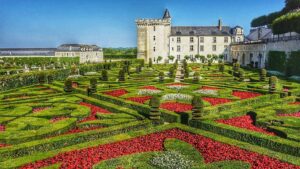
While the interior holds limited interest, the gardens—Villandry’s true glory—are unforgettable. Entirely recreated at the beginning of the 20th century by Dr. Carvallo, they represent the finest example of 16th-century French formal gardens.
Three terraces overlook the Cher: the water garden, the ornamental garden, and the kitchen garden, with geometric beds in Renaissance patterns, enhanced by boxwood arabesques, pathways, and canals. Villandry is a masterpiece of symmetry.
Cinq-Mars-la-Pile
This small riverside village, set below the main road, takes its name from the great tower that rises at its entrance. This massive square “pile”, standing 30 meters high and topped with four small pyramids, dominates the ruins of a medieval fortress above the confluence of the Loire and the Cher.
The monument, of uncertain origin, is built of stone and mortar and faced with brick. Some believe it dates back to Roman times, others to a much earlier period, and still others to the Middle Ages. The reasons for its construction—and what it was meant to represent or commemorate—remain a mystery.
Langeais: from medieval fortress to Renaissance residence
Despite traffic, the best way to enter Langeais is still from the Loire, with the bridge leading directly into the old town and up to the château. Its austere exterior should not deter visitors, as behind the severe façade lies an elegant and well-furnished Renaissance residence, built—unusually—without interruption between 1465 and 1469.
The only remaining trace of the earlier fortress is a ruined keep; everything else was demolished in 1427 on the orders of Henry VI.
Continue your motorcycle escape in the Loire Valley by crossing the Langeais bridge toward Bréhémont, a typical Loire fishing port.


Saché, in Balzac country


A quiet village on the Indre River, Saché is famous for two main reasons. The first is its château, a beautifully situated 16th-century residence near the river, where Honoré de Balzac stayed many times between 1829 and 1838. It was here that he wrote several of his works, including Le Père Goriot (Father Goriot) and Le Lys dans la vallée (The Lily of the Valley).
The rooms once occupied by Balzac are now a museum dedicated to the writer, and his bedroom has been preserved exactly as it was in his time.
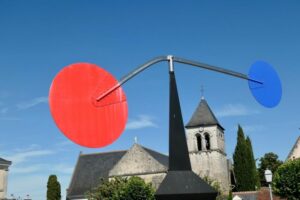
The other, more recent, famous resident of Saché was the American sculptor Alexander Calder, one of whose mobiles can be seen in the town hall square.
Motorcycling through the Indre Valley
East of Azay, the Indre Valley is particularly pleasant and easy to explore via quiet roads, the most attractive of which winds through the trees along the north bank. Crossing old, picturesque bridges, it connects Saché and Pont-de-Ruan, the latter offering the charming sight of two old mills set on small islands.
Further east, also linked to the north bank by a bridge, lies the hillside village of Monts, with its very traditional atmosphere and old-style shops, such as an Art Deco–tiled butcher’s shop façade. Popular with anglers, this peaceful river is also enjoyed by hikers.
Villaines-les-Rochers: the art of basket weaving
Nestled in a valley south of Azay, the charming village of Villaines-les-Rochers is lined with houses along the banks of a small river. Since 1849, the village has been a center of basket weaving, and many residents still work in this craft today.
The cultivation and preparation of willow rods, cut when the stems measure between 80 cm and 2.6 meters, and the making of baskets and objects—an activity carried out year-round—reflect a deeply rooted traditional craftsmanship. Artisans work as families, at home, in small workshops, or at the large cooperative in the center of the village, where visitors can admire and purchase a wide range of traditional and contemporary items. Wicker products are also sold in the small family-run workshops. At the cooperative, a video explains the preparation of the willow and the traditional skills of the basket maker.
The Gardens of the Loire Valley
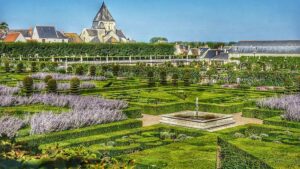
Overflowing with fruit and wine, and flowering even in its smallest villages, the Loire Valley fully deserves its name as the Garden of France. It is also an ideal region for exploring the history of gardening and horticultural techniques. Along the rivers, you can still see the gardens of medieval monasteries, once vital for growing food and medicinal plants.
The great builders of medieval fortresses paid little attention to gardens, but as conflict gave way to lasting peace, castles first became hunting lodges, with the surrounding forest serving as a natural park. They later evolved into elegant and sumptuous residences with structured, grand gardens, designed to reflect mankind’s mastery over nature and to symbolize the triumph of order over chaos.
An unusual visit in the heart of the Indre Valley
The Dufresne Museum at the Moulin de Marnay


As we know, motorcyclists are passionate about anything related to mechanics and engines, whatever the machine. A visit to the Dufresne Museum is therefore a must.
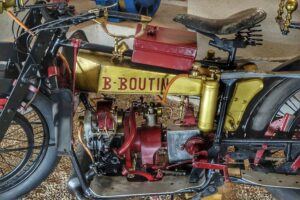
Housed in a former mill on the Indre River, still in working condition, this museum was founded by Maurice Dufresne, a collector and master of salvage. It is packed with vehicles of all kinds, including agricultural machinery, cars, motorcycles, and all sorts of mechanical contraptions.


A true journey through time, showcasing historic machinery to preserve collective memory. Among the highlights are the glider from the film La Grande Vadrouille and a mobile guillotine once used for capital executions. Of course, the museum also features beautifully restored vintage motorcycles.
Where to stay for your motorcycle road trip in the Indre Valley and the Cher Valley?
Hôtel Troglododo (3-star hotel)
A small, charming hotel offering six troglodyte rooms. Set in a valley near the village of Azay-le-Rideau, the rooms—carved directly into the tuffeau stone—are tastefully decorated. A warm atmosphere in a peaceful, countryside setting.
Where to enjoy a wine tasting during your motorcycle trip in Touraine?
After visiting Château de Rigny-Ussé, take time for a Loire Valley wine tasting at Vins & Gastronomie, where Eric will introduce you to a most original sparkling Chinon rosé. You’ll also find a fine selection of regional products such as dried pears (poires tapées), cured meats, Tours nougat, and many other local treats to take home for friends.
Where can you find motorcycle roadbooks for your ride in the Indre Valley?
Our partner Mototrip offers a wide selection of free motorcycle roadbooks, covering one-day or multi-day routes.